10 Recruitment Admin Tasks Stealing Your Team's Phone Time (And What to Automate Instead)
Discover the 10 recruitment admin tasks that kill phone time, backed by VOC data from 1,643 agency sales calls, and how automation gives your team 2-3 hours back every day.

Skip the read. Chat with this article.
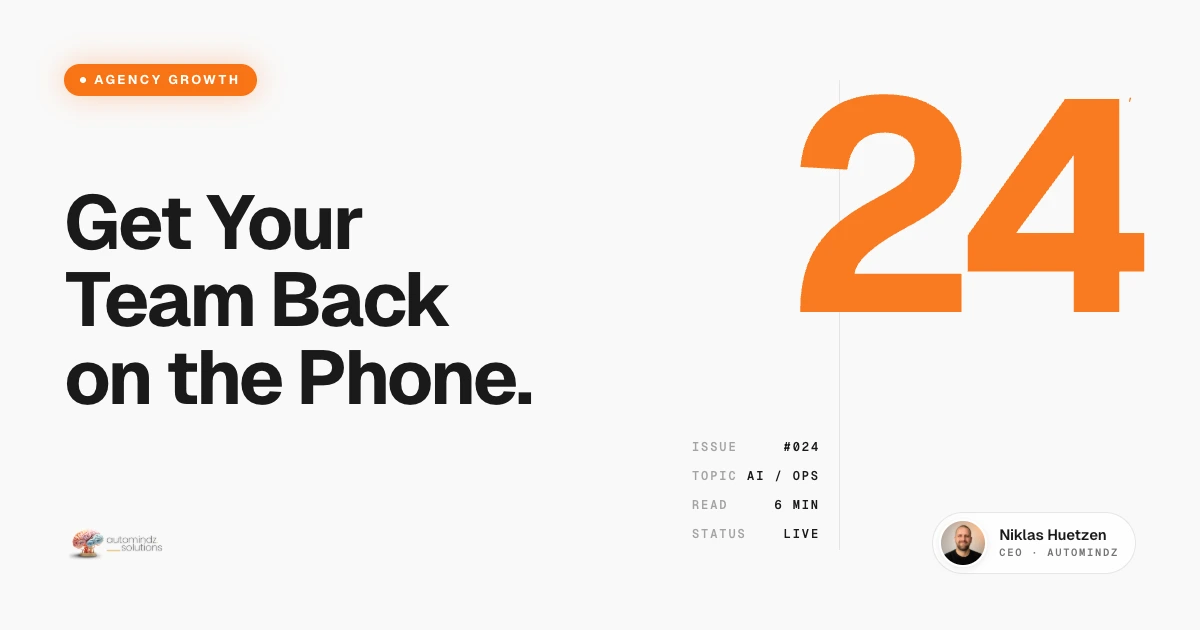
Recruitment admin automation is the practical answer when 80% of your recruiters' day disappears into tasks that generate zero revenue. Per Shortlistd's 2026 research, the average recruiter spends only 20% of their time on calls, BD, and closes - the activities that actually move deals forward.
Why Every Recruitment Agency Founder Wants the Same Thing
Ask any recruitment agency founder what they want more of and the answer is always some version of the same thing: more time on the phone.
Not more LinkedIn browsing. Not more CRM maintenance. The phone - where relationships get built, where candidates get properly qualified, where clients get closed.
There's a structural reason this keeps slipping. When delivery peaks, BD stops. When BD is running, delivery suffers. We call this the Pendle Effect. 90% of agencies swing between the two sides of the desk constantly, and the recruiter sitting in the middle can never maintain both. Something always gets dropped - and it's usually the phone.
The deeper cause is the 10 tasks below. They don't appear on any job description. Nobody budgeted for the hours they consume. But they're taking up the majority of your team's working week.
A 2025 Totaljobs survey of 748 HR leaders found that the average recruiter loses 17.7 hours per hire to manual admin. That's more than two full working days, per vacancy, in lost productivity - roughly £17,000 per recruiter per year. Every one of those hours came from somewhere.
80%
of recruiter time is spent on admin tasks, leaving only 20% for calls, BD, and closures
Source: Shortlistd 2026Wayne Brophy, CEO of Cast UK - a 20-year-old Manchester-based logistics and supply chain agency - described the problem as clearly as anyone we've worked with:
“Not only do they not want to do it, they're not very good at doing it.”
He was talking about experienced consultants with 10-14 years in recruitment being asked to chase leads and manage manual admin. They hated it, they were slow at it, and every hour they spent on those tasks was an hour not spent on the phone.
What Keeps Recruiters Away From the Phone? The 10 Tasks.
1. Building Sourcing Lists From Scratch
This is the single biggest time drain across every agency we've worked with. Automindz's VOC analysis of 1,643 sales calls found it mentioned 94 times - unprompted - as the top operational problem. The typical quote: "List building is the single biggest time sink - anywhere from 10 to 50 hours per project."
Manual Boolean searches, LinkedIn browsing profile by profile, copying names into a spreadsheet, chasing email addresses and phone numbers separately - this is how the majority of sourcing still happens. At 10-50 hours per project, it eats every other activity including calls.
The AI fix: A List Builder agent runs overnight based on the job brief, scores and ranks candidates against fit criteria, and delivers an enriched shortlist each morning. The recruiter reviews it and starts calling. Zero time spent building it.
2. BD Outreach Going Silent During Delivery
1,523 of the 1,643 sales calls in Automindz's VOC dataset mentioned this problem in some form. When delivery is full, BD stops. BD and delivery are competing for the same person's calendar, and during delivery peaks, BD always loses.
This is the mechanical cause of the feast-famine cycle. The two sides of the desk share one resource. Structure is what needs to change - not effort.
The AI fix: A BD Signal Agent monitors job boards, funding announcements, and LinkedIn hiring activity around the clock, scoring new prospects against your ICP and queuing them for outreach. BD runs in the background regardless of what delivery is doing. The two sides of the desk stop competing for the same recruiter's time. Learn more in our guide to signal-based BD for recruitment agencies.
3. CRM Data Entry and Cleanup
446 mentions in the same VOC dataset. Recruiters know their CRM is full of stale records, duplicate contacts, and missing fields. They also know they don't have time to fix it, so they avoid it - and a system nobody trusts gets worse over time.
Data entry after calls, after placements, after every client interaction takes 5-15 minutes each time. Across a full week, that's several hours of typing that could be phone calls.
The AI fix: A Data Steward agent handles deduplication, enriches stale records with current contact data, and archives dead leads automatically. More advanced setups parse call notes and populate CRM fields from free text - so a recruiter's post-call summary becomes structured data with no manual input. n8n workflows connect this layer to Bullhorn, Vincere, RecruitCRM, or whatever ATS the agency runs.
4. Writing Candidate Briefs
A polished candidate brief takes 45-90 minutes to write manually per candidate. CV summary, key skills, salary expectations, availability, a clear rationale for why they fit the role. For a recruiter submitting 3-5 candidates per week, that's up to 7 hours of document formatting.
This is one of the most automatable tasks in the entire recruitment workflow. Most agencies still do it by hand.
The AI fix: A Brief Writer agent takes the CV and the call notes from the qualification screen, then produces a formatted, branded brief in under 3 minutes. The recruiter reviews it, adjusts where needed, and sends. What used to take an hour takes five minutes.
5. Interview Scheduling and Coordination
Shortlistd's 2026 analysis found that scheduling accounts for 38% of recruiter time - the single largest category across the entire working week. 67% of recruiters spend between 30 minutes and 2 hours coordinating each interview. With multiple candidates across multiple active roles, this becomes an enormous daily overhead.
The back-and-forth between candidate and client, the rescheduling when something falls through, the calendar invites, the confirmation calls the morning before - none of it requires human judgment. It just requires someone to do it.
The AI fix: Automated scheduling workflows handle the full coordination loop: availability windows, calendar sync, confirmations, reminders, and rescheduling requests. The recruiter approves the meeting time; the system manages everything from there. Lemlist sequences paired with n8n handle the communication layer; scheduling tools integrated into your CRM manage the calendar side.
38%
of recruiter time is consumed by interview scheduling - the single largest category in the working week
Source: Shortlistd 20266. Manual Follow-Up Tracking and Outreach Sequencing
48% of salespeople never follow up after the first contact. In recruitment, where a client relationship might need 6-8 touchpoints before it converts, that's a quiet and consistent revenue leak.
Recruiters intend to follow up. Then delivery gets busy. The task gets pushed until the prospect goes cold. The manual version - a spreadsheet, a CRM reminder - gets deprioritized the same way the phone does.
The AI fix: A BD Outreach Agent runs sequenced follow-up on a defined cadence. It classifies replies automatically - positive, negative, not now, phone number found in the signature - and routes warm responses to the recruiter immediately. Everything else stays in the sequence. The recruiter only touches conversations that need human judgment.
7. Boolean Searches and LinkedIn Browsing
LinkedIn Talent Solutions data shows talent acquisition professionals spend an average of 13 hours per week sourcing candidates for a single role. 33% of recruiters report spending more than 20 hours per week on sourcing alone.
Manual Boolean string construction, platform switching, filtering by location and seniority, reviewing profiles one by one - it's a legitimate skill and it's also highly systematizable.
The AI fix: Automated sourcing pipelines using LinkedIn's API, Clay for enrichment, and tools like Prospeo for contact verification replace the manual search loop. The recruiter defines the criteria once; the system runs the search continuously and returns ranked, enriched results. For a full breakdown of how this works in practice, read our guide to automating candidate sourcing.
8. Job Board Scraping and Opportunity Spotting
Before a BD call can happen, someone has to identify who is hiring. In most small agencies, that means manually scanning job boards each morning - LinkedIn, Indeed, Google Jobs, sector-specific boards - to spot companies with active openings and decision-maker contact details.
For Sprung Consulting in Switzerland, this meant their cold calling team spending significant time each day browsing jobs.ch and Google Jobs before a single call went out. The callers were skilled at closing. They just didn't have the right leads to call in the first place.
The AI fix: Job scraping workflows pull new opportunities from every relevant board daily and feed them into the BD pipeline automatically. For Sprung, we built custom scrapers for Google Jobs and jobs.ch that identified companies with aging postings, multiple open roles, and repeated listings - signals that a company is actively struggling to hire and is receptive to recruiter contact. Their calling team went from cold prospecting strangers to calling pre-qualified, signal-verified prospects.
9. Pipeline and Activity Reporting
Most agencies run weekly pipeline reviews and monthly performance reports. Someone has to produce these. That means pulling data from the CRM, counting call volumes and response rates, summarizing placement status, and formatting it into something a founder or manager can read in a meeting.
In a small agency, this is often the founder spending Friday afternoon on a task that adds zero billable value.
The AI fix: A Reporting Agent pulls data from your CRM and outreach tools automatically, generates the pipeline summary, and distributes it on a defined schedule. The founder reviews a formatted report. Nobody had to build it manually.
10. Post-Placement Admin, Compliance, and Contractor Onboarding
The Totaljobs research puts 17.7 hours of admin per vacancy - and a significant portion of that comes after the placement, not before. Reference checks, compliance documentation, contractor onboarding forms, GDPR consent records, timesheet setup.
For agencies running contract desks, this operational tail can consume more weekly hours than the original placement process did.
The AI fix: Workflow automation handles the systematic parts: triggering document requests, chasing outstanding paperwork, populating compliance records, and scheduling check-in reminders at defined intervals. The recruiter stays visible on the relationship side. The system manages the paperwork loop.
17.7hrs
per vacancy lost to manual admin - equivalent to £17,000 per recruiter per year in lost productivity
Source: Totaljobs Research, 748 HR leaders surveyed, 2025What Does 2-3 Hours Back Per Day Actually Look Like?
These aren't theoretical numbers. Here's what changed when agencies eliminated these tasks properly.
Sprung Consulting (Switzerland): Their cold calling team was spending most of each day on manual research - browsing job boards, finding contact details, building lists by hand. We built custom job scrapers for Google Jobs and jobs.ch, connected them to an automated email outreach sequence, and routed warm replies directly to the calling team. Callers stopped spending mornings on research and started spending them on the phone. Over six months: 146 interested leads and $184,000 in pipeline from 2,525 contacts.
Cast UK (Manchester): Wayne Brophy's experienced consultants - some with 10-14 years in logistics and supply chain recruitment - had abandoned outbound entirely. The manual admin of lead chasing was so time-consuming and so disliked that the whole team stopped. We built a dynamic outreach engine on top of their existing Bullhorn CRM and Talent Vault - no tools replaced, existing assets connected to a scalable system. Consultants were freed from the top-of-funnel work they hated and were slow at. Result: £100,000 in revenue within 3.5 months, with the two highest inbound inquiry months Cast UK had seen in two years - during a depressed market, over Christmas.
A boutique design recruitment agency we worked with had never run a single outbound campaign - 100% referral-based, with no control over their own pipeline. The first signal-based BD campaign we built generated a $10,000+ retained search in 14 days, with a 22.7% reply rate and 84.6% positive responses from 1,090 emails.
Across all 40+ agencies Automindz has worked with, the pattern is consistent: hours freed from admin go directly to the phone. More phone time means more meetings, more qualified candidates, and more placements.
3.5-4.5x
more likely to hit revenue growth if using AI - Bullhorn's survey of 2,300+ staffing firms in 2026
Source: Bullhorn GRID 2026Where Should You Start?
The temptation is to automate everything at once. That's how you end up with a half-built stack that nobody trusts or uses consistently.
The order that works for most agencies:
- Sourcing and list building first - the biggest time drain, the most automatable, the fastest ROI. One List Builder agent running overnight pays for itself inside two weeks.
- CRM cleanup and data entry second - fixes the foundation everything else runs on. Automation built on bad data produces bad results.
- Brief writing and follow-up sequences third - saves hours per week immediately, with a visible quality improvement that clients notice.
- BD signal scanning fourth - keeps the pipeline full during delivery peaks, exactly when BD would otherwise go silent.
- Scheduling and reporting last - highest leverage over time, but works best when the earlier systems are already feeding clean data into it.
Agencies building this themselves can complete the full stack in 6 weeks with the right structure. Most of that time goes into connecting tools rather than designing agents, which is the problem our own hyreflow solves: 40+ recruiting tools an AI agent can call directly, on the accounts you already pay for. For agencies that would rather have it built for them, BuildOS deploys the full system with a managed outreach campaign live from week one.
Read more on what the full architecture looks like in our breakdown of what a Recruiting OS actually is.
Your recruiters should start each day with leads already researched, briefs already written, and outreach already drafted. Then they pick up the phone.
That's where the 2-3 hours come from.
Frequently Asked Questions
Related Articles

Written by

Niklas Huetzen
CEO & Co-Founder
Niklas leads Automindz Solutions, helping recruitment agencies across the globe build AI-powered pipeline systems that deliver warm meetings on autopilot.
Connect on LinkedIn →Free Resources
Want more like this?
Our Resource Hub is packed with free guides, templates, and tools to help you build AI-powered recruitment pipelines.