How We Book 40 Discovery Calls a Month Without Ever Asking for One
We don't ask prospects to book a call. Not in our ads. Not in our cold emails. Not in our first touch DMs. And we're booking 40+ net new discovery calls a month. Here's the complete breakdown of every layer in our AI-powered demand generation system.

Skip the read. Chat with this article.
AI demand generation works by using AI tools to automate the content creation, lead research, qualification, and nurture processes that traditionally require a full marketing and sales team. Automindz books 40+ net new discovery calls per month using a 4-layer system - an AI content engine, multi-channel traffic driving, intent-based nurture sequences, and a human handover process that turns warm signals into booked conversations.
We don't ask prospects to book a call. Not in our ads. Not in our cold emails. Not in our first touch DMs.
And we're booking around 40 net new discovery calls a month.
Last month:
- 5,000+ website sessions (nearly doubled in 30 days)
- Bookings up 275%
- CTA clicks up almost 80%
- 15+ calls from pure inbound
- 7-10 additional calls per week from Mark's engagement
This isn't some magical growth hack. And I'm going to break down every single piece of this system - the AI tools, the content engine, the ads, the nurture sequences, and the exact handover process that turns a stranger into a booked call.
No gatekeeping. This is how it actually works.
Why Value-First Demand Generation Beats "Book a Demo" CTAs
Most B2B companies run this playbook:
- Create an ad
- Point it to a "Book a Demo" page
- Hope someone fills out the form
- Wonder why conversion rates are garbage
Or they just send random cold emails with a "got 30-minutes this week to discuss?" CTA.
The math on that approach usually isn't mathing. You're asking a cold stranger to commit 30 minutes of their time before they know if you're worth even 30 seconds of it.
We flipped it.
Every single touchpoint in our system delivers value before making any ask. The playbook, the blogs, the newsletter, the LinkedIn content - all of it is designed to educate, build trust, and let the prospect self-qualify on their own terms.
By the time someone gets on a call with us, they've typically:
- Read our playbook (or significant parts of it)
- Seen our content on LinkedIn multiple times
- Received a series of emails with genuine frameworks they can implement themselves
- Watched a YouTube video or two
- Looked us up independently
Most calls we take aren't cold. They're with people who already understand what we do and are figuring out if it's the right fit for their agency.
275%
increase in bookings after connecting all 4 demand gen layers
Source: Automindz Internal Data
The system has 4 layers. Let me walk through each one.
Layer 1: How Does an AI Content Engine Actually Work?
Content on multiple platforms is the fuel for everything else in this system. Without it, the ads have nothing to point to, the emails have nothing to link, and the LinkedIn presence would be non existent.
The problem is content takes time. A lot of it. Creating good, original stuff consistently while also running a business is a real constraint.
So we built an AI content engine using Claude Code that handles the heavy lifting while keeping everything in our voice and grounded in real data.
You might think "ooohh this is AI slop" - it's not.
I call it AI augmented content creation. Every piece comes from real data, ideas, journal entries, insights and context we produce. AI just helps making sense of all the stuff that we produce every day across client conversations, sales calls, industry news, following other creators and research sessions our agents do.
Mining for Insights
Before we create a single piece of content, we mine for insights from 5 sources:
1. Our Wiki
We maintain an internal knowledge base compiled from case studies, call transcripts, market research from our AI agents, and content + competitor analysis. It covers everything from our core methodology (signal-based BD, the recruitment flywheel, 80/20 targeting) to industry data (Bullhorn GRID stats, market adoption rates) to client patterns we've observed.
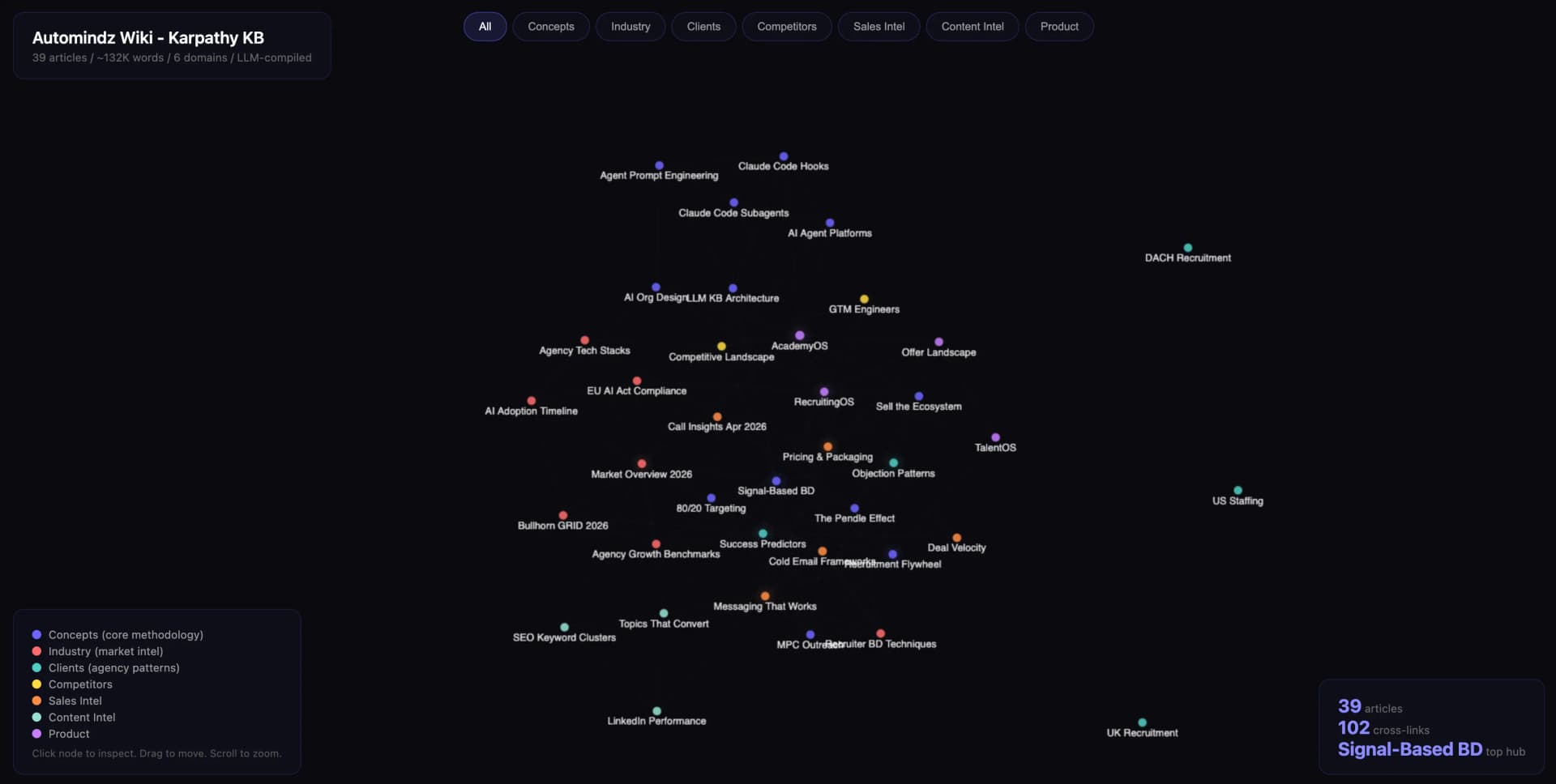
Why this wiki is great for contextual search is, that each article is linked with reference articles, meaning an LLM reads one article, sees linked articles that go deeper into specific related topics and reads the ones it thinks are relevant for context too.
Here is an example of how the link between wiki articles looks like (btw Claude built this visualization within one prompt):
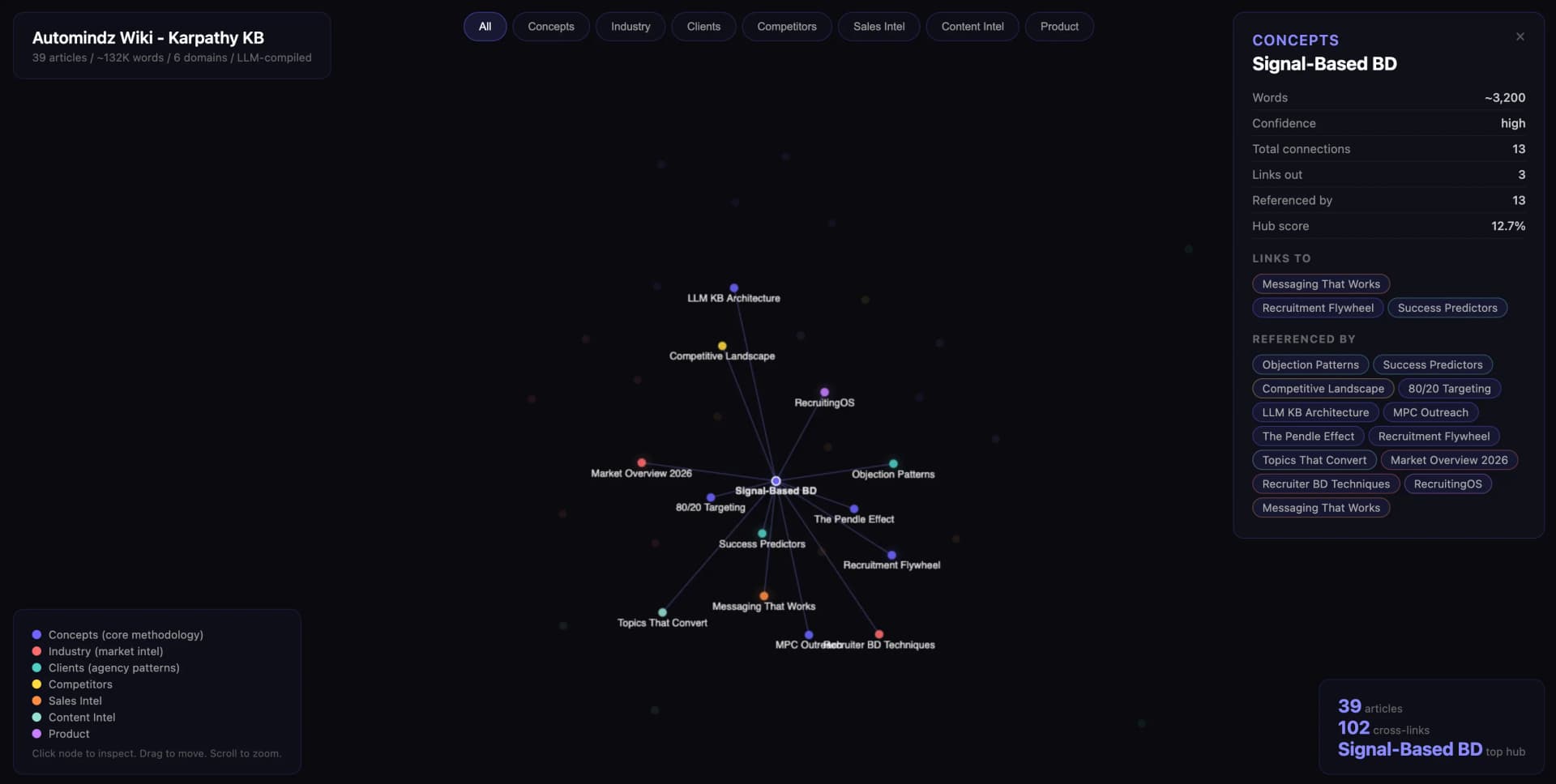
This is always the first stop. The data is verified, the terminology is ours, and the angles are ones nobody else has because they come from our work with 40+ agencies.
2. AI Idle Research
This one might sound wild but hear me out.
We have a Claude agent that runs autonomously multiple times a day. It scans the web, Reddit, X, LinkedIn, GitHub, and industry sources for new developments in AI, recruitment tech, automation tools, and market shifts. It scores each finding for relevance to our business, saves structured summaries, and even maintains its own backlog of things to research deeper. Then sends me a Telegram message with a quick recap what it found.
Every morning I wake up to fresh research waiting for me - content fuel I didn't have to go find myself.
3. Call Transcripts
Every sales call gets recorded and transcribed via Fathom. We mine these for real prospect language, common objections, questions that keep coming up, and patterns in what agencies are struggling with.
This is gold for content because you're literally writing in the words your audience uses. When a prospect says "I'm drowning in admin and my recruiters spend 60% of their time on data entry" - that becomes a hook.
4. Content Performance Data
We track what's working across LinkedIn, X, and our blog. Top-performing hooks, engagement patterns, which post formats drive the most comments vs saves vs DMs. The system identifies what resonated so we can create more of it and less of what didn't land.
5. GSC and GA4 Data
Google Search Console tells us what people are searching for and where we're showing up but not getting clicks. GA4 tells us which pages are converting and which ones are leaking visitors. Both feed directly into content decisions.
All of these insights are stored in Supabase. The table updates itself with fresh ideas generated on a schedule where Claude runs through the sources and mines for new angles.
Creating Content Across Platforms
Now think about how long it would take you to go through all of this manually, then picking what has potential and then creating ideas out of it. You'd be doing nothing else anymore.
We have dedicated Claude Code skills that create drafts for each platform. Each one loads our voice guidelines, a hook library of 50+ proven templates (built from analyzing 1,400+ viral LinkedIn posts), a CTA playbook, and performance data from our previous posts.
Here's what each skill does:
/content-create - This skill starts with either an idea I give it or it suggests ideas based on the content insights table which fills itself from content mining. It then asks for which platforms I want to create drafts for. LinkedIn, YouTube and X. It then loads up the reference files for the platforms to create for, writes the drafts and adds them to Supabase. I can then edit them in our content studio (which is a custom built content editing page where I see the post preview etc. - just a gimmick I liked).
Blog - GEO-optimized articles designed to rank in both traditional Google search AND AI search results. We'll look into this in detail in a second.
Before drafting, each skill checks what hooks we've used recently (no repeats), what content pillars need coverage, and what topics are trending. It cross-references the content pipeline to make sure we're not publishing the same angle twice.
The result: I go from "I need a post about X" to a platform-native draft in about 5 minutes. Review, tweak, and publish.
Current output I generate with this:
- 3-5 LinkedIn posts per week
- 2-3 X posts per week
- 1 YouTube script per week
- 1 newsletter per week
- Blog posts on a rolling cadence
And this is just me. My Co-Founders are pushing content too.
The Blog Engine
The blog is our organic search traffic generator and it deserves its own section because it's a serious piece of the system.
We currently have 21 published posts. All of them are written by Claude using the system below.
The blog creation skill handles the full pipeline and works conversational. Meaning it aligns topics, context mining and other details that steer the articles direction with me before executing the next step.
This is the step-by-step process:
- Topic selection based on keyword gaps from Search Console, prospect questions from call transcripts, hot topics and content pillar balance
- Internal context mining - pulls from our wiki, case studies, and existing posts to find angles that are uniquely ours
- GEO optimization - this is key. We structure every article for AI search engines, not just Google. That means clear entity definitions, direct answer formats, FAQ sections, and structured data that LLMs can parse and cite. We're already seeing AI referral traffic double month over month from ChatGPT, Claude, Gemini, and Perplexity combined.
- Writing in our voice with real data, real workflows, and actionable frameworks
- Publishing directly to our Supabase-powered CMS with SEO metadata, hero images, and internal linking that published straight to Vercel
We also repurpose every blog post into 6+ content pieces across platforms. One blog becomes LinkedIn posts, X posts, YouTube scripts, newsletter content, and social snippets. A single well-researched article feeds the content engine for weeks.
Traffic Analysis and Optimization
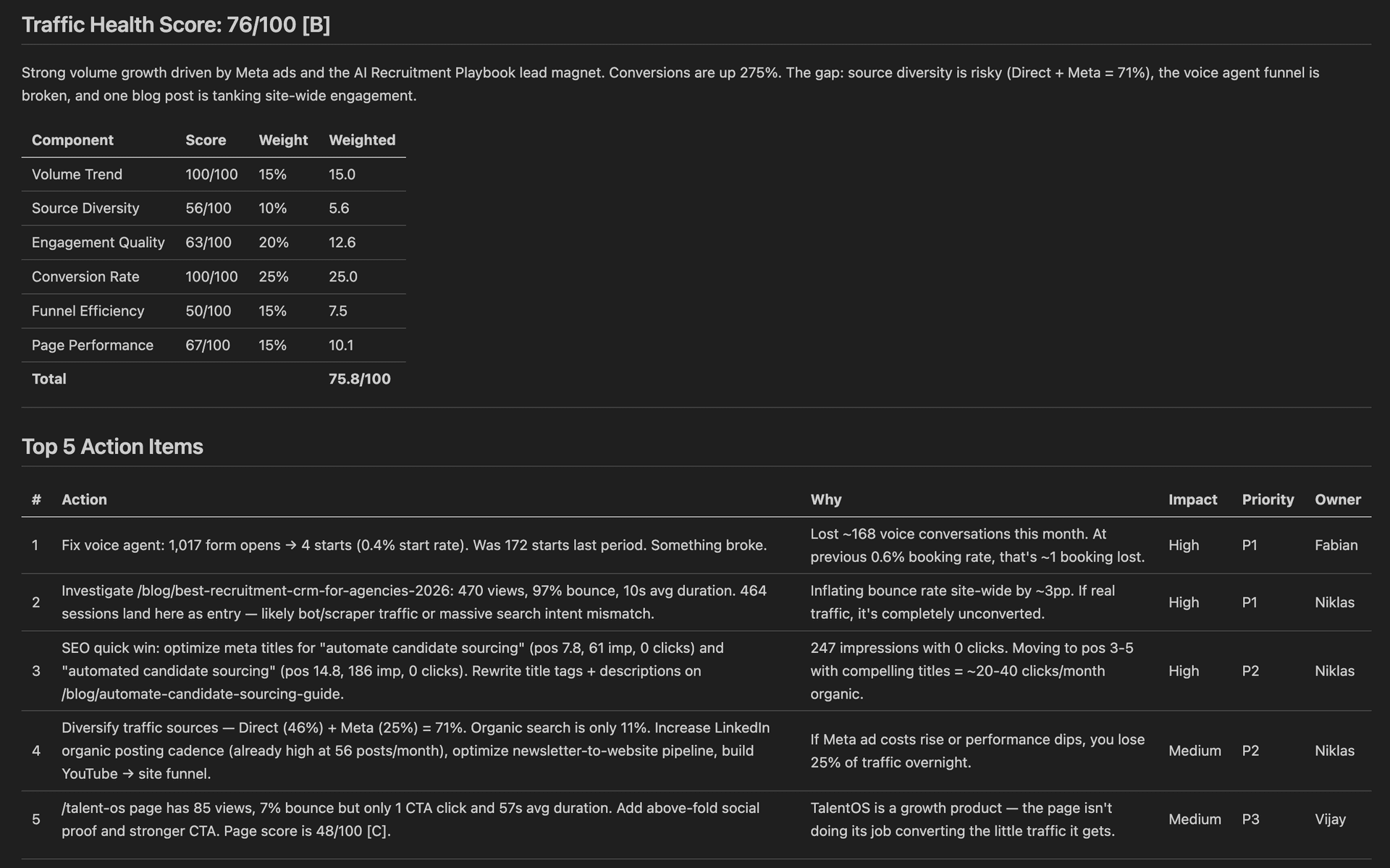
Every month we run a comprehensive traffic analysis but when I say analysis...this isn't just a "check the numbers" - it's a structured diagnostic Claude Code does using a skill that generates:
- A Traffic Health Score (0-100) across 6 dimensions: volume trend, source diversity, engagement quality, conversion rate, funnel efficiency, and page performance
- Page Scorecards grading every key page on bounce rate, duration, CTA click rate, and entry rate
- Conversion Funnel Maps showing exactly where visitors drop off between landing and booking
- SEO Quick Wins - keywords in positions 4-20 where a title tag rewrite could start driving clicks tomorrow
- Prioritized Action Items with clear owners and impact estimates
All of this data comes from Google Analytics and Google Search Console we wired into Claude Code to be queriable whenever we need to know about our website traffic.
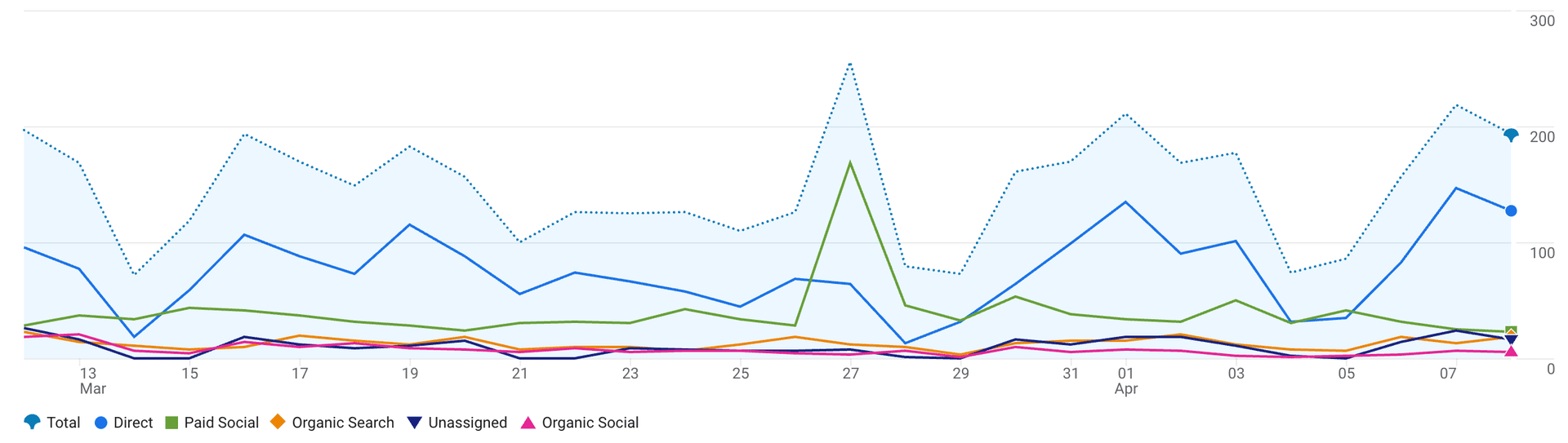
This month's score was 76/100. Strong on volume growth and conversions. Gaps in source diversity (too dependent on Meta ads + direct traffic) and one broken voice agent widget that killed potential conversations. Shame on us.
But every finding feeds directly back into the system. A task is created in our board that is maintained by Claude that it picks up itself. A blog post with a high bounce rate gets investigated. A keyword at position 7.8 with zero clicks gets a meta title rewrite. A page with low CTA rates gets social proof added above the fold.
The traffic analysis IS the optimization engine. It tells us what to fix, what to double down on, and where the leaks are.
Layer 2: What Drives 5,000+ Monthly Sessions to Your Website?
Content without distribution is a journal entry. Here's how we actually get people to the site.
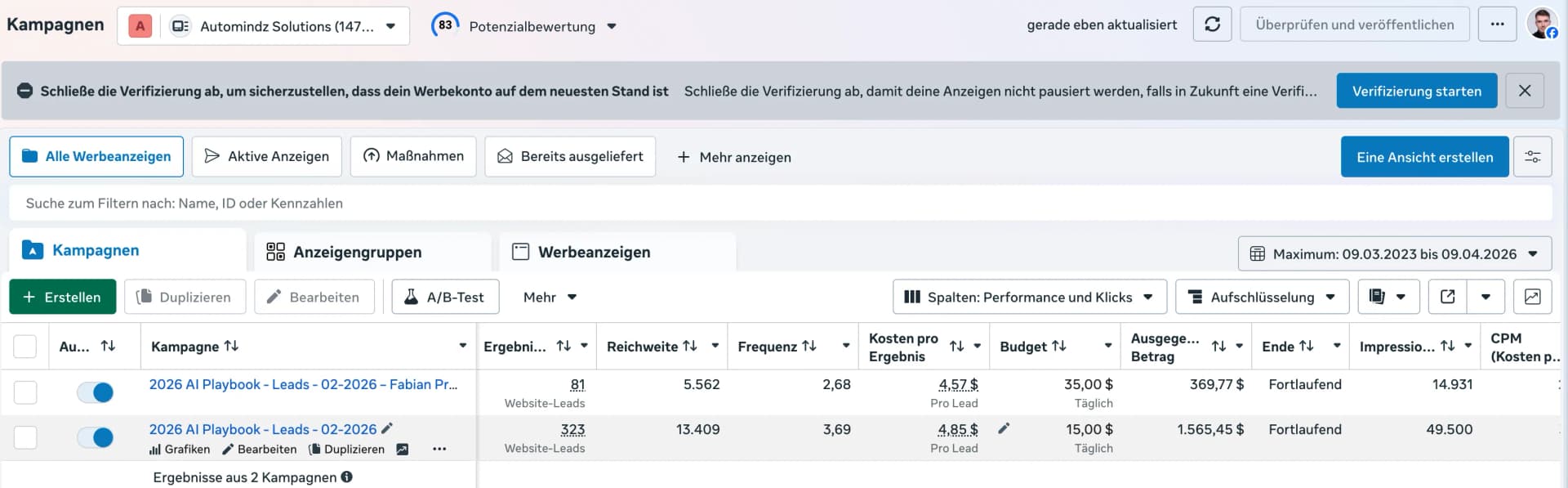
Meta Ads (Around 25% of All Traffic)
We run image ads across Meta (Instagram + Facebook) from our company page and our personal profiles. Every ad is playbook-specific. Currently working on adding more video ads to diversify creatives and avoid hitting too high frequencies on the images.
The setup:
- Creative: Image ads right now, video ads in production
- Targeting: Broad recruitment and staffing interests + lookalike audiences built from custom prospect lists we've uploaded
- Destination: All ads point directly to the playbook page
- Cost: Around $5 per lead magnet signup
- Volume: 1,250+ sessions last month
27%
CTA click rate from Meta ad traffic to the playbook page
Source: Automindz Internal Data
The Meta traffic converts at a 27% CTA click rate. 335 lead generation events from those sessions. People who click a Meta ad, land on the playbook, and then engage deeper - that's the signal that matters.
We're not optimizing for call bookings at the ad level. We're optimizing for playbook engagement and signal collection. The calls come later through the nurture and handover layers. We first want to get them into our funnel, educate and nurture them so we're not getting into conversations that are too cold.
Cold Email
Our cold email campaigns follow the same value-first principle. No meeting asks on first touches. Every sequence routes to a value page:
- Email 1: Asks them if they are interested in a particular resource solving a pain point
- Email 2: Link to the playbook
- Email 3: Link to a relevant case study or blog post
- Follow-up: Only after they've shown interest do we suggest a conversation
If you want to go deeper on how we structure outreach for recruitment agencies, check out our 7 BD outreach plays breakdown. And if you're running cold email, deliverability is the foundation you need to nail first.
The beauty of this approach: even if someone doesn't reply to the email, they might read the blog post, bookmark the playbook, and show up as an inbound lead a few weeks later. The touchpoint compounds even when the direct response doesn't happen.
Organic Search
552 sessions from Google organic last month. A lot of it is branded search right now - people searching "Automindz" after seeing us on LinkedIn or in an email.
The non-branded organic pipeline is where we're investing and it's growing. Our SEO analysis identifies quick wins based on page rankings and for which keywords we can improve. Then suggests where to focus the efforts on. All of that feeds back into the blog post engine.
Moving these candidates from page 2 to page 1 with better titles and descriptions could add more organic clicks per month. Even small numbers compound - organic traffic usually comes with a high intent. Every blog post we publish adds another keyword cluster to the portfolio.
AI Search and GEO
This is the one everyone should be paying attention to.
Our AI search traffic doubled last month, meaning we're popping up when people asking their LLMs for advice. This is high trust traffic we're getting from there.
14.3%
conversion rate from Claude AI search referrals with 429s average session duration
Source: Automindz GA4 Data
Claude's referrals are wild - 429-second average duration and a 14.3% conversion rate. People who find us through Claude's AI responses are seriously engaged.
This is why every blog post we write is GEO-optimized. The traffic may be small today. It won't be in 12 months. The ones showing up in AI search answers now will own that traffic as it scales.
LinkedIn Organic + YouTube
LinkedIn organic drives 220+ sessions through post link clicks and profile visits. YouTube is tiny (28 sessions) but converts at nearly 30%. People who watch a 10-minute video and then visit the site show up educated and ready.
Both channels we're doubling output on. YouTube especially - a 30% conversion rate from even 100 sessions per month would be a meaningful pipeline contribution.
Other Traffic Sources
Apart from these there's other direct traffic sources, something we're actively working on attributing more and more. The juice is in the data so it's important to know where people that land on your page come from. Referrals from our tool partners, link clicks without parameters etc. - every blind spot needs to go.
Layer 3: How Do You Turn Anonymous Traffic Into Booked Calls?
Traffic is step one. What happens after someone lands is where the system gets interesting.
First-Party Intent Signals
Not everyone who reads the playbook is ready to talk. Most aren't. And pushing them to a call too early kills the relationship before it starts.
Instead, we collect signals:
- Playbook download - They clicked the CTA and want the full resource
- Resource hub signup - Gated content library with deeper frameworks and tools
- Newsletter signup - Explicit opt-in for ongoing education
- LinkedIn follow/connect or like/comment - Social intent signal
- Return visits - Someone who comes back 3+ times in a week is showing real interest
- Blog engagement - Reading 2+ articles in a session, especially high-intent pages like case studies
Each of these tells us something different about where someone is in their decision process. A playbook download is curiosity. A resource hub signup plus return visit is consideration. Multiple blog reads plus a LinkedIn follow is "I'm evaluating you."
Beehiiv Newsletter Sequences
Every signup - whether it's the playbook, resource hub, or direct newsletter opt-in - gets enrolled into our Beehiiv newsletter.
Not a "buy now" email blast. It's a structured sequence designed to build trust and familiarity over time:
Early emails (Week 1-2): Pure education. Core frameworks explained. How signal-based BD works. What the recruitment flywheel looks like in practice. Real numbers from agency builds. Zero selling.
Mid emails (Week 3-4): Deeper content. YouTube videos embedded. Case study links. Blog posts that go into tactical detail. They start seeing our thinking and methodology regularly.
Later emails (Week 5+): Gradually more direct. "If you're serious about building this for your agency, here's how we work with clients." By this point they've received 5+ emails of genuine value and they know who we are, how we think, and what results look like.
The asks get more direct as trust compounds. But even the later emails lead with a piece of value before suggesting a conversation.
44%
return rate from resource hub signups - nearly half come back after the initial signup
Source: Automindz Internal Data
Return rate from resource hub signups: 44%. Nearly half come back after signing up. The sequence is working.
Layer 4: The Human Handover That Closes the Loop
This is where the system meets the real world. AI builds the pipeline. Humans close it.
Automatic Research and Qualification
When a lead shows meaningful intent, the automation kicks in:
Step 1 - CRM Entry The lead is pushed into Attio (our CRM) automatically. Gets assigned a status and added to our active prospect list.
Step 2 - Auto Research The system researches them automatically - company size, tech stack, recent activity, LinkedIn profile, any previous interactions with our content. This used to take 15-20 minutes per prospect. Now it happens in seconds.
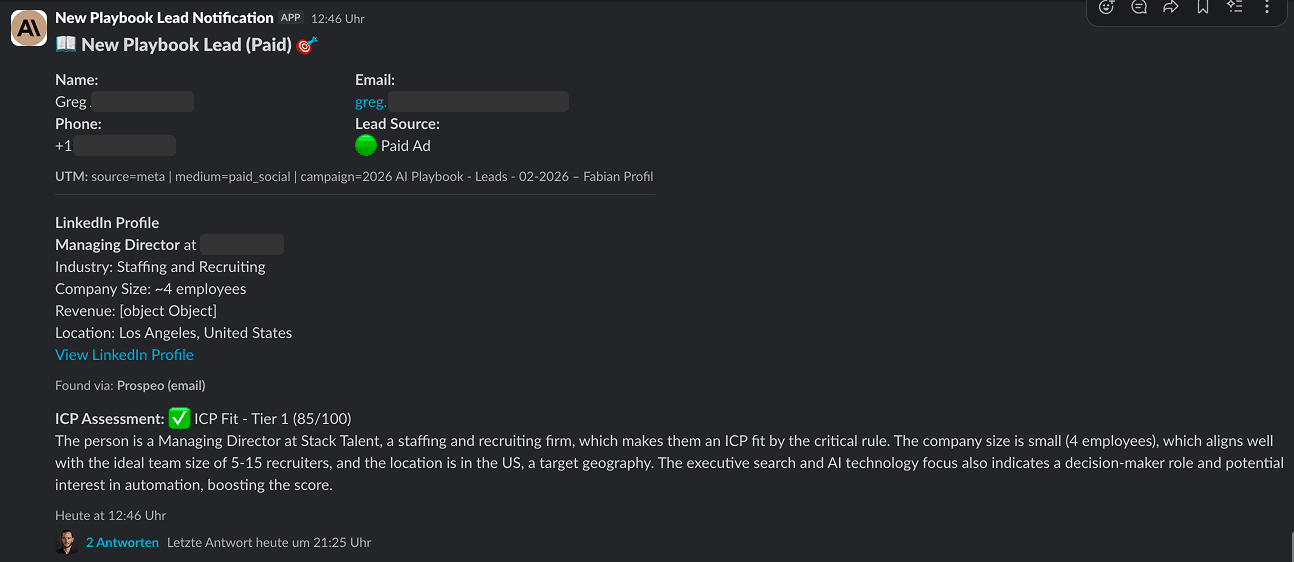
Step 3 - ICP Qualification Are they a recruitment agency? In our target market (UK, US, DACH)? Decision maker or influencer? Right revenue range? The system qualifies them against our ideal client profile and flags anything relevant.
Step 4 - Slack Notification A formatted notification drops into our team Slack channel with the full research summary. Everyone sees what just came in. The prospect's background, their likely pain points, which content they engaged with, and a qualification score.
Lemlist Sequences
Qualified leads are automatically enrolled into a Lemlist sequence. Here's what fires:
1. Team-wide LinkedIn connection Automated connection requests go out from the whole team. When the prospect accepts any of us, they start seeing our content in their LinkedIn feed organically. More touchpoints. More familiarity. By the time we reach out directly, they've seen us around.
2. Call tasks for Mark Every qualified lead generates a call task in Lemlist assigned to Mark. He can see the full auto-research profile, the intent signals that triggered the sequence, and can dial them directly from the platform. No context switching, no "let me look them up first."
3. Multi-channel coordination LinkedIn messages, email, and phone are all coordinated through Lemlist so the prospect doesn't get hit from every direction simultaneously. The touches are sequenced and spaced so it feels natural, not aggressive.
Mark's Daily Routine
Mark is generating 7-10 calls per week through this process and this is what a typical day looks like (apart from him running discoveries).
Morning: Check new qualified leads that came through overnight. Review the auto-research summaries in Slack and Lemlist. Prioritize by qualification score and intent signals. He does this with a single message in Claude CoWork which is connected to Attio - so he immediately sees who's new, has contact details and can do further research using his skills.
Late morning: Work through call tasks. Dial directly from Lemlist. The research is already done - he goes into each conversation knowing their agency size, what they're working on, which content they downloaded, and what their likely pain points are.
Afternoon: Send personalized messages to people who accepted connection requests. Follow up on warm leads who've been through 3+ touchpoints.
Throughout: Flag any hot prospects in Slack for the team. Update Attio with call notes. Move leads through the pipeline stages. Cool side effect here is that Claude CoWork also runs his call reviews, updates the CRM and creates deals in a standardized format. Everything is logged based on our standard using specific Claude Skills.
The critical difference: Mark is rarely cold calling a stranger. Most people he contacts have already:
- Downloaded our playbook or signed up for the resource hub
- Been auto-researched and qualified against our ICP
- Started receiving educational newsletter content
- Connected with us on LinkedIn
By the time he dials, they know who Automindz is. The conversation starts at "I saw your playbook, tell me more about how this works" instead of "who are you and why are you calling."
Inbound: 15+ Calls Per Month on Autopilot
On top of Mark's outbound engagement, we book 15+ calls per month from pure inbound. People who:
- Read the playbook and click "Book a Strategy Call"
- Found us through Google, YouTube, or LinkedIn and navigated to the booking page themselves
- Got referred by an existing client or someone in their network
- Saw enough newsletter content to decide they want in
“No "hey can I get 15 minutes of your time." No cold pitch in the DMs. No "book a demo" as the first touchpoint. Just value, signals, timing, and a human who knows exactly when and how to reach out.”
What We're Optimizing Next
The system works. But there are obvious gaps we're fixing:
1. Source Diversity 71% of traffic comes from Direct + Meta. That's too concentrated. If ad costs spike or Meta's algorithm shifts, we lose a quarter of traffic overnight. We're increasing organic search, YouTube, and newsletter-to-site traffic to spread the risk.
2. SEO and GEO Improving our organic rankings and getting referenced by AI search engines is a top priority for us and it plays well with our content engine we are running anyway. The plan here is to create more and to distribute more. More is more - it's simple.
3. Video Ads Image ads are performing very well already. Video should convert even better for lead magnet offers because you can demonstrate the value in 30 seconds. Currently in production.
4. YouTube Volume A 30% conversion rate from YouTube referrals is insane. But the numbers of sessions a month is tiny. Doubling YouTube output starting this month.
Building a System That Compounds
You can copy any individual tactic here. Run Meta ads to a lead magnet. Set up a Lemlist sequence. Write blog posts.
But the reason this generates 40+ calls per month is that all the layers work together.
The content engine feeds the ads, the blog, and the social presence. The ads and cold email drive traffic to value-first pages. The lead magnets and blog posts capture intent signals. The newsletter builds trust over time. The auto-research and qualification ensure no lead falls through the cracks. And Mark converts warm, educated, pre-qualified prospects into calls.
Remove any layer and the numbers drop. Add them together and they compound.
If you want to see what this looks like applied to a recruitment agency, check out what a Recruiting OS actually is or how we build AI agent teams that handle the operational heavy lifting.
We help recruitment agencies build bespoke AI systems - from top of the funnel and demand generation systems like this to efficiency systems that help you clone your best recruiters' workflows into repeatable workflows the whole team can execute.
Drop me a DM on LinkedIn if you want to learn more.
Speak soon.
Cheers, Nik
Frequently Asked Questions
Related Articles

Written by

Niklas Huetzen
CEO & Co-Founder
Niklas leads Automindz Solutions, helping recruitment agencies across the globe build AI-powered pipeline systems that deliver warm meetings on autopilot.
Connect on LinkedIn →Free Resources
Want more like this?
Our Resource Hub is packed with free guides, templates, and tools to help you build AI-powered recruitment pipelines.